Strategy and Craft Aren’t Mutually Exclusive
Don’t let titles fool you. Many of mine read strategic, leadership, transformation. While true, I’ve never stepped away from the work itself. Every work sample and case study shown below represent projects I personally designed, developed, and delivered — from storyboards, development, and video to train-the-trainer, LMS configuration, and field delivery.
Strategy informs my work; craft keeps it credible.
Sample Work Products

Sample Micro-Course (Storyline 360)

Sample course developed in Articulate Storyline 360 with embedded video elements using Vyond and Camtasia Studio. It demonstrates a sample course in applying change management principles to field training projects in the construction industry.
Tools: Articulate Storyline 360, Vyond, Camtasia Studio, Miro (storyboarding), Camtasia Studio, Snagit.
Sample Storyboard (Miro)
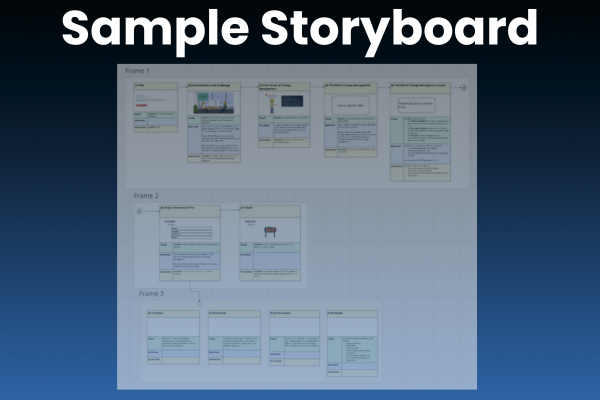
Do I storyboard before I start development? You betcha. This is a one page snapshot of the storyboard used for one of my recent courses. I typically flow these out using Miro.
In keeping with my philosophy to start small, launch lean, prove value, and to scale what works: I start with storyboard sketches to review with stakeholders before scaling to course development.
Tools: Miro, Snagit
Sample Micro-Course (Rise 360)

This work sample showcases a self-paced micro-course created to illustrate how change management practices were applied in a real project for an international construction company. Designed as a leadership-level overview, the course highlights the importance of integrating change management practices into project planning.
Tools: Articulate Rise 360, Miro (storyboarding), Camtasia Studio, Canva, Snagit.
Use Cases and Case Studies
Build-Measure-Learn Framework for Internal Learning Programs
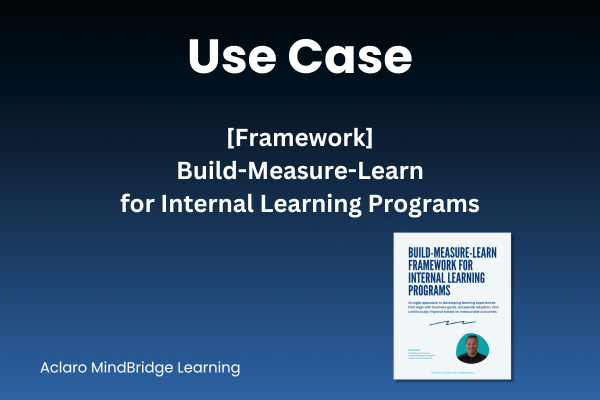
It’s not uncommon for L&D teams to launch “finished” courses and wait months for results while following a waterfall development process. Build-Measure-Learn is a development option that focuses on short cycles to launch a minimal, job-tied learning experience and iterate quickly so leaders see movement and scale only what works. This framework shows how we aligned on success metrics, instrumented the experience, ran rapid debriefs, and rolled improvements forward.
AI-Enabled Roleplay
This experience demonstrates a use case where AI is used to enhance a roleplay exercise. This example uses the use case of practicing emotionally intelligent conversations. It can be customized for other use cases, including: capturing institutional knowledge by “interviewing” retiring SMEs, sales, difficult conversations, etc.
The widget is active (try it!) and uses a Zapier chatbot layer with an API to ChatGPT for AI processing. (Other AI platforms are supported.) The chat layer can be embedded in various venues including: webpages, Sharepoint pages, self-paced LMS courses, Slack chats, or similar platforms.
AI-Enabled Prompt Sandbox
This experience was developed to support a training program in an organizational AI adoption initiative. It illustrates a practice environment that new users of generative AI can use following a foundations course for AI Fundamentals.
(See also Note 1 below.)
This sandbox allows learners an opportunity to practice writing effective prompts and receive feedback in a “safe space.”
It uses a rubric to grade the user’s attempts. It uses weighted scores for a prompt framework comprising elements that consider the AI’s role, goal, audience, context, constraints, examples, and output format.
The widget is active (try it!) and uses a Zapier chatbot layer with an API to ChatGPT for AI processing. (Other AI platforms are supported.) The chat layer can be embedded in various venues including: webpages, Sharepoint pages, self-paced LMS courses, Slack chats, or similar platforms.
Note 1: I’m experienced in developing and delivering courses in multiple modality, including live, virtual, self-paced, or hybrid learning programs.
Change / Adoption Framework
This AI Adoption Framework reflects my broader approach to Change Management and enterprise adoption. I share it here as an example of how I think about aligning leadership intent, operational readiness, and workforce enablement when organizations introduce new technologies.
It’s not meant to replace an existing strategy you may already have. Rather, it shows my readiness to support you in translating leadership priorities into practical activities that helps teams coordinate change initiatives, measure adoption progress, and build momentum.
Also included below is a short video of a sample Change Management / Adoption dashboard built in Prosci Proxima. Prosci is a change adoption methodology. Proxima is the dashboard I use to provide leadership with visibility to adoption progress, barriers, and change readiness across their organization.
Click the image below to watch the demo. It shows how the dashboard can support your change initiative by making adoption measurable, visible, and actionable for project leaders and sponsors. If useful, a similar dashboard can be implemented to support your own transformation efforts.
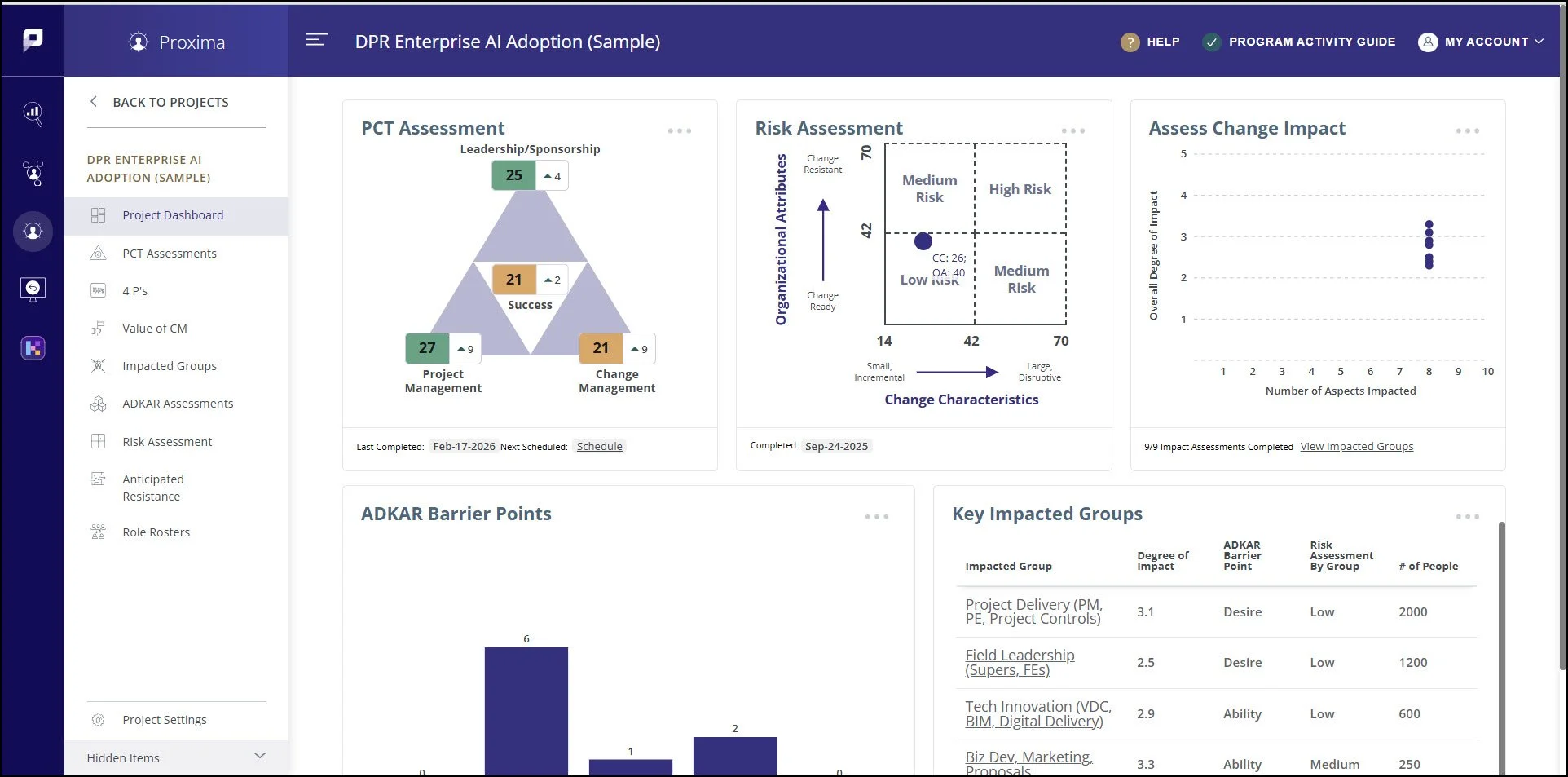
Click the image above to watch the explainer video.
Click here to visit a read-only version of the dashboard.
Accelerating Learning at an International Construction Firm

The traditional course development cycle at this international construction company spanned 8 to 12 months—too slow to meet the urgent needs of a water facility enhancement project in Colorado. Project leaders needed a solution that could prepare engineers with field-relevant, hands-on skills in weeks, not months. Here’s how we did it in 8 weeks.
Aligning Instructional Development Methods in a Decentralized Enterprise

In a decentralized construction enterprise, training development was fragmented—corporate L&D followed a traditional waterfall model, while field teams demanded rapid, just-in-time enablement to support high-priority self-perform work. With no shared system to guide methodology or prioritization, course development was often delayed, misaligned, or overengineered for field realities.

Case Studies
MindBridge Learning
Get in touch.
Reach out to explore how we can support your next L&D initiative through fractional leadership, course design, or agile development.